For any digital marketing campaign to succeed, it needs to have unrelenting focus on search engine optimization (SEO) and search engine marketing (SEM). Both are important branches of the big and tall digital marketing tree and both are overwhelmingly keyword dependent. Without a laser focus approach on keyword research, you are highly unlikely to succeed in SEO and SEM. This means that your digital marketing campaign will end up missing on invaluable amount of organic and paid traffic and your lead generation and conversion numbers will appear anything but flattery. To help you fix this problem, this blog post will systematically breakdown the concept of digital marketing keywords, largely focusing on how to find the right keywords for your digital marketing campaign.
This blog post is largely meant for SEO beginners and mid-level SEO professionals.
Why SEO and SEM are keyword oriented?
To dissect the concept of digital marketing keywords, first and foremost we need to know what makes SEO and SEM so overdependent on keyword research. Why are they so bounded by keyword research while other forms or other types of digital marketing (like email marketing, digital PR and social media marketing) are not even scarcely dependent on keyword research.
The answer to the question lies in the way search engine functions.
Most search engines including Google are able to lend their search services only when people insert keywords in it and press ‘search.’ That’s how search engines have been operating ever since it popped up nearly two decades ago and that’s how it operates even today. Even if people want to conduct voice search, they still have to verbally mutter out certain keywords.
Simply put, Keywords are the heart and soul of search engines.
SEO and SEM revolves around this fundamental fact, targeting the very keywords that people are searching for on search engines. However, it preferably chooses to target only those keywords that have high search volume or keywords that are largely searched by large number of people. That’s because these keywords have the huge potential to bring abundance of traffic, and with it the opportunity for lead generation, sales and conversion.
Unless search engines find different way to function in the distant future, both SEO and SEM will continue to remain keyword oriented.
Now let’s divert our focus on some of the popular terms and terminologies associated with keyword research. These terms and terminologies are integral part of the keyword research exercise. Knowing and understanding them will better understand how to make keyword research, which we will be talking about in the next section.
- Search volume.
- Keyword difficulty score.
- Search intent.
- Trending keywords.
Search volume: It refers to the average number of times a specific keyword is searched during a given period of time (usually a month) on search engines like Google.
Keyword difficulty score: Keyword difficulty score, usually denoted as KD%, is one of the important metrics. It shows a rough estimate about how difficult it would be to rank a specific keyword on the first page of the search result.
Keyword difficulty is measured on the scale of 0% to 100%. Keywords that are more near to 0% are easier to ranks while keywords that are nearer to 100% are difficult to rank.
Search intent: Search intent is another important metric. It reveals what exactly the users are searching for while conducting a search on the search engine. Whether they are searching for a information on specific topic or searching for a particular website or researching a product or service.
Search intent is usually classified into four types:
- Informational (when users are searching for information).
- Commercial (researching a product or service before buying it).
- Navigational (searching for a particular website – Twitter.com or Facebook.com)
- Transactional (want to buy a particular product or service on a e-commerce website).
Keyword trending:
Trending keywords refers to those keywords that consistently enjoys steady volume of search all through out the year as opposed to those keywords that enjoys temporary spike in search volumes only during a short period of time in a year. These keywords are often referred as non-trending or seasonal keywords.
Usually, SEO professionals target trending keywords as they are likely to bring more traffic to the website.
So, these were the four important terms or factors that need to be considered while doing keyword research. There are few other terms but these four are the most important ones.
How to find the right keywords in digital marketing?
We’ve finally arrived at the core topic of this blog post, how to find keywords that will drive lots of traffic to your or your client’s website. To achieve any semblance of success on this critical front, you need to have right set of tools at your disposal.
These tools provide invaluable data about which keywords in your niche have high search volume or which keywords are comparatively easy to rank for. This knowledge or information is priceless as it helps your website to navigate through the over-crowded world of SEO and rise to the top spot of the search result page.
List of popular tools for keyword research:
All these tools are all in-one-SEO tools, which means that these tools offer more features beyond keyword research, like backlink analysis, tracking keyword rankings, website audit etc.
All other important questions about tools have been thoroughly answered in the next section. To get more clarity, kindly go through the same.
Now we will show how to conduct keyword research and find right keywords by using the SEMrush tool. Kindly note that you can use different tool as per your convenience and choice.
Once you log-in to your SEMrush account, you will see several signs in the extreme left-hand side. You need to go to the top and move your cursor to the sign that says ‘Seo Dashboard.’ As soon as you place your cursor on it, it will flash a long list of menus.
In that long list of menus, you need to click on the option ‘keyword magic tool’
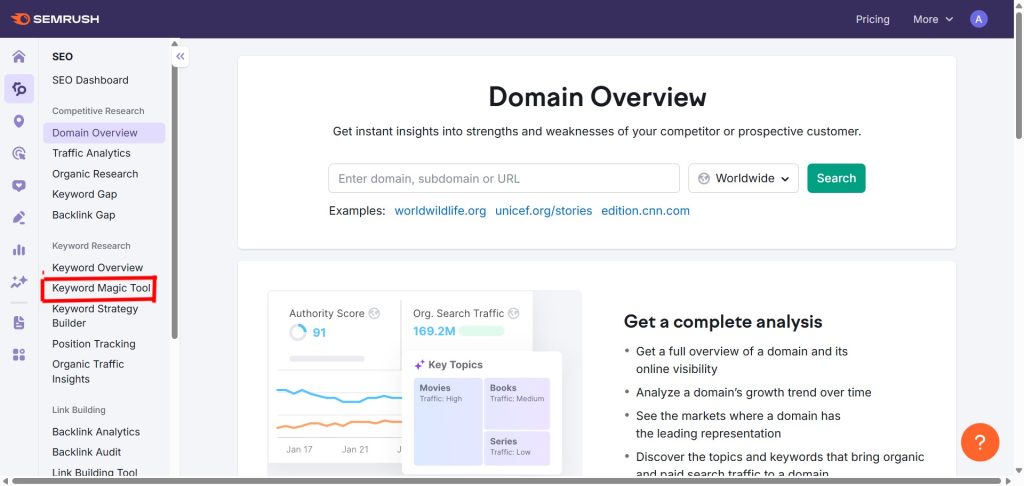
keyword magic tool is one of the top offerings and features of SEMrush. Whenever you want to conduct keyword research on SEMrush, you always need to head to keyword magic tool.
This is how the SEMrush keyword magic tool page looks like.
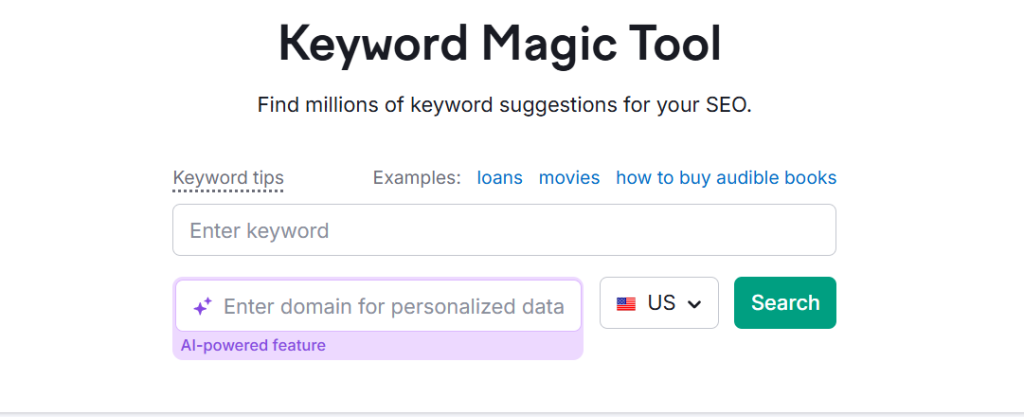
You simply have to type keywords associated with your niche in the box and press ‘search.’
You can also change ‘location’ or ‘region’ at the bottom. Currently, we have chosen the US location and, therefore, we will get the result for US location.
For the sake of this example, we have typed the keyword ‘content marketing’ and hit search.
You can see the results in the below screenshot.
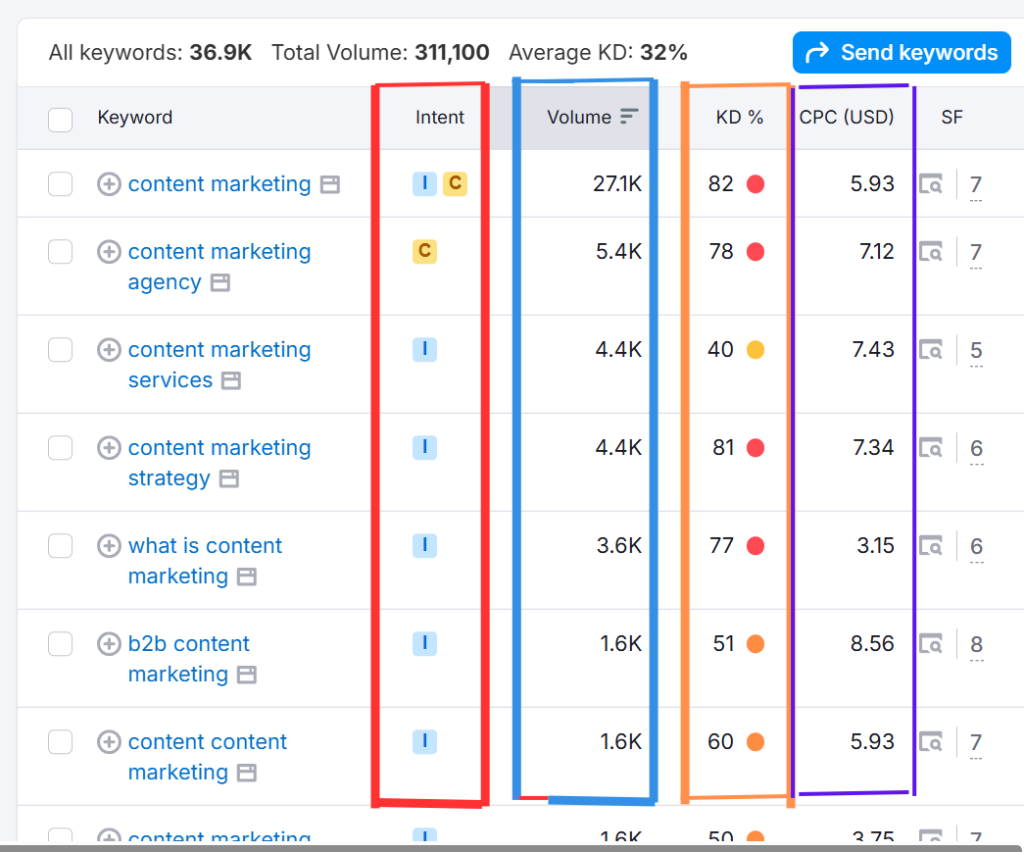
As you can clearly see in the above screenshot that we’ve marked several columns in vertical boxes displayed in different colors.
The first box marked in red color is showing search intent. The second box marked in blue color is showing search volume, third box in orange color is showing keyword difficulty score (KD%) and the fourth box showed in purple color is showing CPC.
Except for CPC, we had discussed all other metrics in the above section and hence we won’t discuss about them in great detail here. As for CPC, it stands for cost-per-click, telling us the approximate price of keywords that helps in efficiently optimizing the SEM and Google ad campaigns.
Another important thing to note are the filters that are placed on the top.
Kindly check the below screenshot. In the screenshot, filters are marked in the red line.
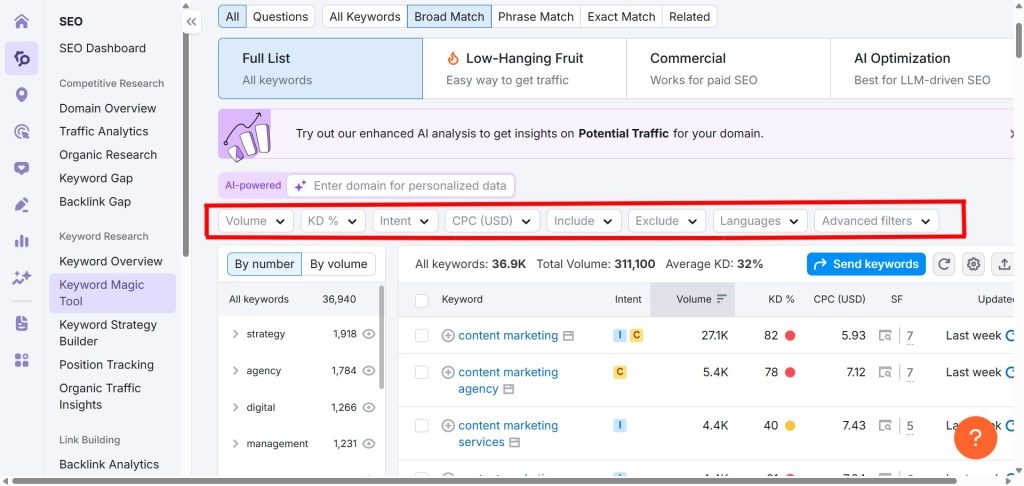
As you can clearly see that filters are also labelled with the same name, intent, KD% and search volume. You can make changes to the filter enabled options as per your requirement.
In the below screenshot, you can see that we have adjusted the keyword difficulty score filter. Likewise, you can adjust other filter enabled options.
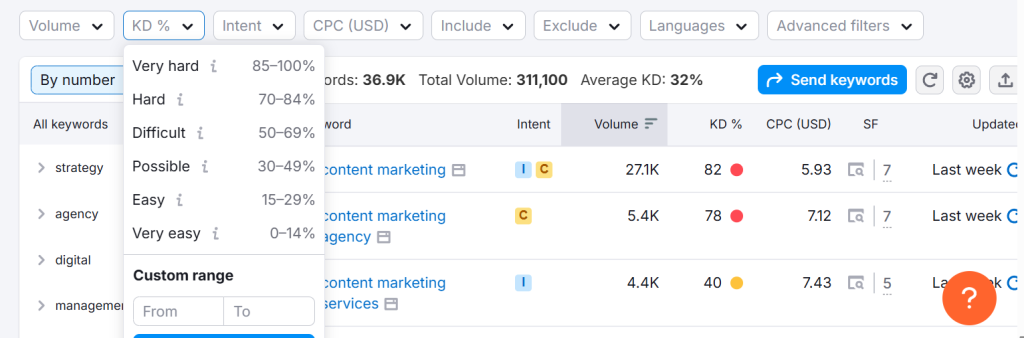
As you click on the KD% filter, you will see many options like very hard, hard, difficult and possible among other options. In this case, we’ve chosen the option ‘possible.’
This means that keyword magic tool will only show those keywords that are possible to rank on the first page of the search result. If you closely notice the KD% filter options, you’ll see that KD score is mentioned beside every option. Like in the case of ‘possible,’ the score ’30 – 49% is clearly mentioned.
We’d already informed in the above section that keywords whose KD score is near to 0 but further away from 100 are relatively easy to rank for.
The below screenshot shows all the keywords that are possible to rank for.
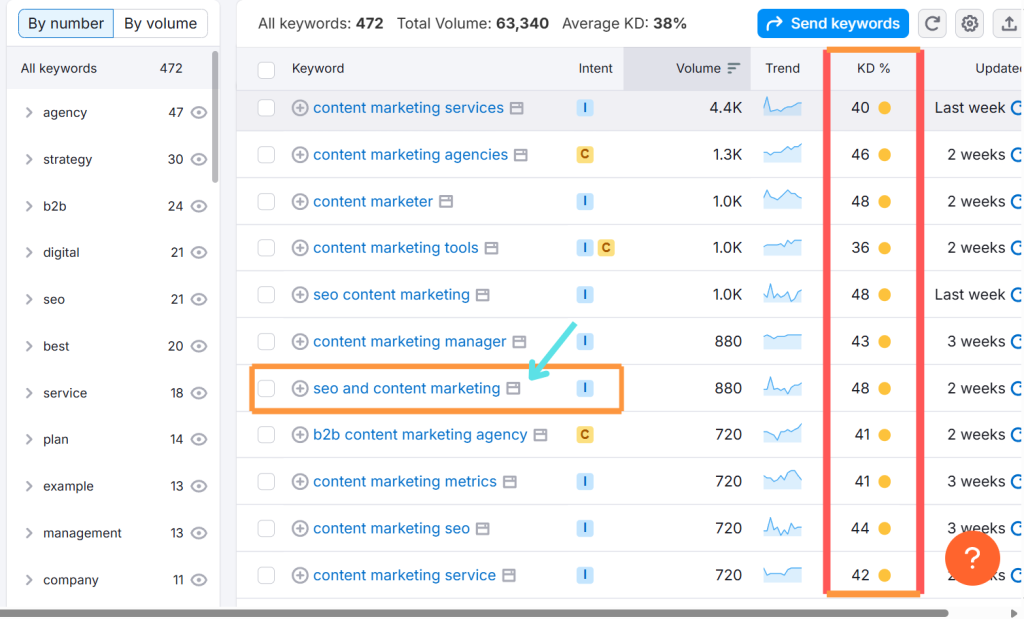
The keyword difficulty score or KD% is marked in a vertical box with red color. Since we had selected the possible option, only keywords falling in the range of 30-49% KD score are displayed.
Kindly note that SEMrush allows you to import all the data or selected keywords to excel sheet. However, in this case we’ve selected only one keyword ‘SEO content marketing,’ which will be the primary keyword for our latest blog. As you can clearly see, ‘SEO content marketing’ has a search volume of 880 and keyword difficulty score of 48, which are favorable metrics for our high authority website. What is also good about these keywords is that it is a trending keyword
You can also check out the SERP of the selected keyword by clicking on the small box located just beside the keyword. In the above screenshot, we’ve indicated the small box with a blue color arrow.
If many are confused about what keyword score that their website should be targeting then this will largely depend on their website’s domain authority. If the website has a higher domain authority then it can easily target keywords with high difficulty score, while websites having low domain authority should go after keywords with low keyword difficulty score.
Kindly go to SEMrush’s domain overview feature for checking any website’s domain authority.
For the sake of clearing out all the confusion, below we’ve mentioned step-by-step guide about how to conduct keyword research with SEMrush.
- Log into your SEMrush account.
- Move your cursor to the SEO menu, second in the menu list option located in the extreme left-hand side.
- You’ll see long list of options. Click on keyword magic tool.
- You can start the keyword research exercise by typing any keyword related to your niche and the results featuring all the keywords associated with that particular keyword along with all the metrics will be displayed.
- You can adjust the filters based on your requirements as has been explained above.
Conducting keyword research with SEMrush any other popular SEO is extremely easy. All the SEO tools are user-friendly and hence getting acquainted with their features and tools shouldn’t take much time.
Frequently asked questions (FAQ):
Q) Is it possible to conduct keyword research without tools?
Answer: No. It is not possible. You always need a good tool at your dispoal. Tools give access to invaluable and important data, without which conducting a proper keyword is nearly impossible.
Q) Are there any free keyword research tools available?
Answer: Yes, there are plenty of free tools that can be easily found on internet. However, most of these tools not only provide limited set of data but even accuracy of their data is questionable.
Q) Is It feasible to use Google Keyword Planner for keyword research?
Answer: You can certainly use Google keyword planner, which is the part of Google Ads, for keyword research. However, its limited features could potentially impede your keyword research and also your SEO campaign. For instance, Google keyword planner does not provide keyword difficulty score, which as we now know is an important metric in the keyword research. Nor does it show the list of top keywords that your competitors are ranking.
Q) How to check keywords that your top competitors are ranking for in SEMrush?
Answer: Go to ‘Domain Overview’ feature and paste the URL of any of your top competitors. It will show several data about your competitor including top keywords that it is ranking for.
Q) What are the prices of the basic monthly plans of some of the popular SEO tools?
Answer: The price of SEMrush’s basic plan starts from $129.95, Ahrefs $99 and Ubersuggest $12.
Q) Are the data provided by SEO tools 100% accurate?
Answer: The data provided by top SEO tools like SEMrush and Ahrefs have the accuracy of 60-70%, which is good enough to give competitive advantage to your keyword research and SEO campaign.
Conclusion:
Once acquainted with all the features of the top SEO tools, finding winning keywords in digital marketing campaign becomes fairly easy. You’ll able to find keywords that could unlock huge amount of organic traffic as well as increase the success chances of your SEM campaign. Keyword research essentially gives a navigational path and direction to your digital marketing, It tells exactly which keywords you need to focus on and which keywords have to be filtered out. These type of invaluable data often provides an overwhelming advantage to your digital marketing campaign and access to such priceless data is only possible through keyword researh.