Traditionally, public relations or PR have always played an important role in brand building exercise. There probably isn’t a great brand in this world that hasn’t leveraged the capability of PR. Over the last one decade or so, PR has ventured deeply into the digital space and has literally become a standalone industry in itself. Today that industry is referred as Digital PR.
Although it would be wrong to refer Digital PR as a standalone industry, over the years it has emerged as a powerful force that it has almost overshadowed traditional PR. Therefore, it was only a matter of time that the SEO professionals would leverage the power of Digital PR. Moreso, because their world invariably intersects and converges, since both greatly rely on digital space for their survival.
What really is Digital PR, after all?
As I’ve already hinted that any PR activity taking place in the digital space is referred as Digital PR. In other words, it is simply a digital version of the traditional PR.
Let us now look into what all activities come under Digital PR.
The way I see it, digital PR can be essentially divided into three parts,
- Content Creation & Distribution
- Relationships & Community Building
- Monitoring & Measurement
Here are some of the activities that come under each of the above mentioned branches.
Content Creation & Distribution
- Guest blogging
- Blog outreach
- Press releases
Relationships & Community Building
- Journalist & influencer outreach
- Social media engagement
- Online reputation management
Monitoring & Measurement
- Track brand mentions and sentiment
- Analyze campaign performance
- Competitive analysis
Why has Digital PR become so important in SEO?
I have already clearly mentioned that today digital PR has become an important tool for most SEO professionals. But the question is why? The answer lies in the fact that it helps in opening the floodgate of organic traffic for your website. And this eventually opens up the possibility of scores of potential leads and conversions, which is what ultimately most people – be it a small brand or big company – want.
Speaking strictly from the SEO perspective, I personally consider Digital PR as the the truest form of ‘white hat” link building.’ Link building, as I have often mentioned, is one of the toughest tasks in SEO. However, digital public relations can greatly minimize the pain and inconvenience involved in this task.
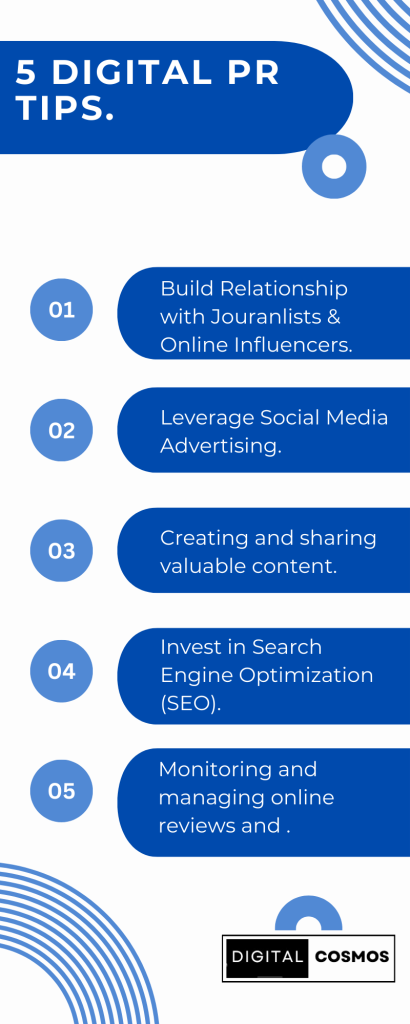
The singular and the most primary aim of any digital public relation campaign is to increase the trust worthiness of your brand across the digital landscape. As the trust increases, people tend to speak about your brand more frequently, leading to lots of brand mentions, positive reviews and lot of social media signals. More often than not this ultimately leads to a good number of high-quality backlinks, which finally opens the floodgate of organic traffic for your website.
Simply put, trustworthiness has a positive trickle-down effect on your website’s organic traffic.
It is also important to note that as people begin to trust your brand, so does Google.
To simplify things further, below I have mentioned a very simple formula:
Increase in trustworthiness = increase in backlinks = increase in organic traffic.
Now I want to share some hard data and statistics about digital PR’s positive impact on the overall organic traffic of a website.
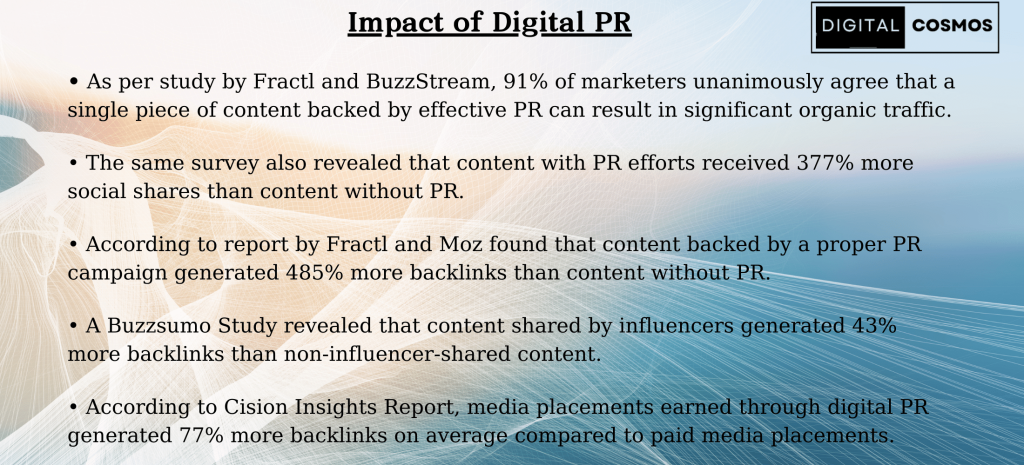
I can share more statistics and data that convincingly proves about digital PR’s overall positive impact on SEO and digital marketing campaign.
Some of the data shared above sheds light specifically on the positive impact on backlinks and link building. I have also underscored the positive impact on backlinks through above mentioned formula.
In this context, I would like to again repeat that once a dedicated digital PR campaign firmly establishes the trustworthiness of your website or product, you no longer need to go hunting for backlinks. Websites including high-authority websites begin to link to your websites on their own. They are more than willing to associate with websites or product/services that enjoys positive traction and is repeatedly getting positive reviews from the end consumers.
That’s exactly why I mentioned earlier in this blog post that digital public relation campaign greatly eases the enormous pain and effort that goes into building backlinks.
I can’t overstate this fact enough that any PR activity, be it online or otherwise, is ultimately all about evoking ‘trust’ among the desired target audience.
Should you do Digital PR inhouse or outsource it?
One of the major predicaments that you could face is that whether you should do digital PR through your inhouse employees or simply outsource it to a third-party agency. The latter option assumes that your company has a pretty decent budget at its disposal since most PR agencies charge a pretty hefty fees for their services.
Your final decision should ultimately rest on several important factors. The same has been shared below:
- Do you have good contacts with journalists who work in good media houses.
- Do you have equally good contacts with social media influencers.
- Does your inhouse team has the talent to craft compelling content (this is important for publishing blogs & guest posting).
- Does your inhouse team has the skills and experience in social media marketing.
If the answers to most of the above question is ‘yes’ then then it is always better to settle for inhouse. However, if the answer is mostly ‘no’ then it be wise to opt for third party agency. It is important to know that Digital PR is a specialized job and hence getting it done from highly experienced and skilled people would be most prudent and sensible thing.
Tools needed for Digital PR
Today there are tools available for every damn thing and Digital public relation is not an exception. Mentioned below are some of the tools that can prove to be highly effective for conducting a successful digital public relation campaign.
- BuzzSumo
- Haro
- Muck Rack
- Cision
- Unbounce
- Meltwater
- Hunter