Most digital marketing career aspirants lay lot of emphasis on learning Google ads. Knowing how to run ads on Google ads proficiently and fechting valuable leads for the clients is one of the valuable skillsets that any digital marketer could have. If you are reading this article with great interest then this means that you know couple of things about Google ads and possibly preparing for an interview for the position of Google ads executive or paid marketing executive.
To help you and all the aspirants out there in cracking this interview, I have prepared top questions that are usually asked in most interviews. Each question is followed by a brief yet expertise answers that will give you the required confidence and clarity in cracking the interview.
All the answers mentioned below are based on my practical experience that I’ve secured after working on Google ad projects for several clients.
What is Google Ads?
Many readers may certainly know what Google ads is but I still felt the need to offer a basic introduction about this ad platform.
Google ads is an online ads platform owned by Google. It provides platform to advertisers to display their ads on Google’s search results and partner websites. One of the central features of this ad platform is the close bidding system where advertisers get to bid on keywords. If their bidding is above the desired benchmark and have also fulfilled other important criteria then their ads will successfully appear in Google ads.
Another distinguishing feature is that it works on pay-per-click (PPC) basis, which implies that advertisers only pay when users or viewers click on their ads.
On this note, let us dive into the main topic of this article
Top Google Ad Interview Questions
Q) Can you explain how Google Ad works?
It basically works on a bidding system. The bidding system decides the ad position based on maximum bid placed for the keyword and the overall quality score of the ad. Higher the maximum bid and quality score, the better are the chances of your ads being placed on top of the SERP page.
Q) What really is Quality Score?
Quality score is assigned to individual keywords on the scale of 1-10. Quality score is calculated based on several key factors like keyword relevancy, overall quality of the landing page, click through rate and ad text relevancy. Quality score also takes into account the historical performance of the ad account.
If an ad account is new then it will most certainly won’t have much historical data, which could negatively affect the quality score.
Q) What are different types of bidding strategies in Google Ads?
Advertisers can choose from different bidding strategies that Google Ads has to offer. The same are as follows:
- Manual CPC.
- Enhanced CPC.
- Maximize clicks.
- Maximize Conversions.
- Maximize Conversions Value.
- Target Impression Share.
- Target cost-per-acquisition (Target CPA).
- Target ROAS (Return on Ad Spend).
- Cost Per Thousand Impressions.
- Cost Per Thousand Viewable Impressions.
- Cost-Per-View.
- Portfolio bid strategies.
Q) What is the difference between CPM, CPC and CPV bidding?
CPM refers to cost per thousand impression bidding where the advertisers pay for per thousand impressions their ads receive irrespective of the number of clicks on their ads.
In CPV, which refers to Cost Per View, you pay for each unique view that your ad has received.
CPC stands for cost per click, referring to the amount advertisers pay for each click.
Q) What is Manual CPC and enhanced CPC?
Manual CPC is a popular bidding strategy where advertisers set the maximum amount they are willing to pay for each click on their ad. This means that they have full-control over the cost of each click, allowing them to adjust bids for individual keywords based on their performance.
Enhanced CPC is often used in Manual CPC bidding. It essentially helps in fetching more conversions from manual bidding, permitting Google to automatically adjust or change those bids based on the likelihood of a conversion.
Q) What are keyword matching option in Google ads
Keyword matching options basically allow advertisers to choose keywords that will eventually help in triggering their ads in the Google search results. These keywords help their ads in reaching relevant and targeted audience.
Keyword match options, which are also called as keyword match types, can be broadly divided into four types:
- Broad Match
- Broad Match Modifier (BMM)
- Phrase Match
- Exact Match
Q) What is IP Address exclusion in Google Ads?
IP Address exclusion in Google ads refers to a feature that prevents your ads being shown to particular users who are accessing your ads through specific IP addresses. This feature is usually used when advertisers fear that their ad performance could be manipulated through fake clicks.
Q) What actions you should take if your ads get disapproved?
If your ads get disapproved then you will immediately receive notification on your registered e-mail id, stating the reason for disapproving your ads. You will also receive direct notification on your Google ad account. Based on the stated reason, you will accordingly have to take the required action.
In most cases, you will have to make changes in the text of your ad copy or content of your landing page and then resubmit the ads for approval. Most ads get disapproved either certain text in the ad copy or certain content in landing page is not adhering the Google ad guidelines.
Q) What are ad extensions and what different types of extensions?
Ad extensions are additional piece of information that advertisers can add to Google Ads campaign into order to improve the user engagement and the overall performance of ads. By performance of ads, I am specifically referring to improving the CTR of the ad.
Google ads offer total 10 type of extensions
- Sitelink Extensions
- Callout Extensions
- Structured Snippet Extensions
- Call Extensions
- Location Extensions
- Price Extensions
- App Extensions
- Promotion Extensions
- Lead form extensions
- Affiliate Location Extensions
Q) What are negative keywords?
Advertisers are allowed to add negative keywords to their ad campaigns. By adding negative keywords, advertisers are basically telling Google ads that these keywords are irrelevant to their products and therefore their ads should not be triggered by these keywords.
Adding negative keywords help in preventing irrelevant traffic, reducing the ad spend wastage as well as in improving the quality score.
Q) How to calculate CTR in Google ads?
You can calculate CTR in Google ads by applying the following formula: (Total clicks / Total impressions) X 100.
Q) What are the decisive factors that eventually decide your ad position in Google’s SERP?
Bid amount and quality score are two decisive factors that eventually determine your ad position in Google’s SERP page.
Q) Is it possible for your ad to appear on top of the SERP page even though your bidding rate is lower than your competitors?
Yes, it is very much possible for your ads to appear on top of the page even with low bidding rates. However, this is possible only when your quality score is higher than your competitors. Quality score plays a very important role in determining the cost-per-click or CPC you’ll pay for your ads.
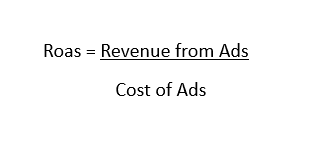
Q) If you have chosen Target ROAS as your bidding strategy then how will calculate ROAS?
The formula for calculating ROAS is as follows:
Q) is it possible to run location-based ads?
Yes, it is very much possible to run location-based ads. You can run your ads in international regions where you are not physically present by choosing the targeted countries from the location tab. Once you choose a specific country or countries, your ads will run only in selected country/countries.
You can also narrow down your ads to specific states, cities towns of a specific country.
Q) What is ad Group in Google ads?
Ad groups is a set of multiple ads and their related keywords. Ad groups are created within a campaign. One of the benefits of creating ad groups is that it helps in managing and optimizing your campaign more efficiently as it allows you to monitor performance at the ad group level and accordingly make changes in your ad groups as per your observation. Additionally, it also helps in properly organizing and structuring your entire campaign.
Q) What are different types of access level in Google ads?
There are total four types of access
- Administrative Access: People with administrative access have sweeping rights – they can add or remove users and change the access levels of all the participants.
- Standard Access: They enjoy fewer privileges. They can view and make edits in the ad campaigns but cannot add or remove any users. They are equally prohibited from making certain changes in the account setting.
- Read only access: As is evident from the name, users can view and read all parts of account and cannot make any changes.
- Email-Only Access: They will receive reports regarding performance and notifications on their registered mail id. However, they will not have any direct access to ad account.
Q) If you are a digital marketing agency or a freelancer then what type of access will request from the ad account holder?
I will be asking for Standard access from account owner.
Conclusion
Cracking and mastering Google ads interview questions is an important ladder to climb if anyone aspires for a successful and enduring career in digital marketing. I am hopeful that the above comprehensive guide has provided the valuable insight into what kind of questions you can expect during the interview process. However, apart from the theoretical knowledge, it is equally important that you keep honing your skills and stay updated with latest features and development in Google ads. Practical knowledge will give you more hands down knowledge about all important aspects of Google ads and make you well prepared for the interview.