If you’ve started reading this blog post with great interest then it means that you’re either new to guest posting or someone who is an SEO amateur still trying to learn the tricks and trades of one of the common SEO practices. I can assure you that this blog post will prove to be a great enlightening experience for whosoever wants to learn or update themselves about guest posting.
As I’ve promised in the ‘title’ that this blog post is going to be an ‘ultimate guide’ and therefore I’ve tried to make it as comprehensive as possible.
In the world of SEO or online marketing, guest blogging is considered one activity that cannot be compromised on. Probably no SEO campaign can achieve desired results without incorporating this activity, though there are few exceptions to this (will address this in some other blog post). This brings me to the question of ‘why.’ Why this practice is considered so indispensable in the SEO strategy? Before addressing this question, let us first address an even more fundamental question of what is guest posting really?
Definition of Guest Posting
The term guest posting implies that you’re some sort of invited guest, which is actually true. But here you aren’t invited to any function or party. Rather you’re invited as a guest to a third-party or another website for writing an article. Writing a guest post article offers several benefits, some of which are very critical for SEO. Not only it helps in projecting you as an expertise or industry leader in a specific niche but also helps in generating much needed traffic for your website.
The latter, which is actually critical aspect of SEO, is possible by placing a link in the guest post article. A link that invariably points to your website and is popularly referred as backlinks.

As I already mentioned that guest blogging offers several advantages but none of the remaining benefits are as priceless as backlinks.
SEO has undergone several changes during last few decades but one thing has remained unchanged and will probably remain so even in the distant future. The popularity of guest blogging method for acquiring backlinks.
While it is very much possible to acquire backlinks through social media, digital PR and other methods, guest blogging still remains the most popular method.
Kindly refer to the below image to know about all the benefits of guest posting.

What are the Best Practices of Guest Posting?
Finally, we’ve arrived at the main theme of the blog post. Like everything under the sun, guest blogging also has best as well as bad practices. Best practices obviously help in keeping your website’s reputation in Google’s good books and this ultimately propels your website in Google’s SERP.
Kindly note that the best practices discussed below are not directly subscribed by Google. However, the SEO industry as well as SEO veterans widely considers them as golden rule. Therefore, if you sincerely adhere to all these practices and if all other things remain equal then your guest blogging efforts will certainly yield desirable SEO results.
On this note, let us finally head to the best practices.
- Target high authority or reputable website:
The number one principle of guest posting or link building outreach is that you should always try to post your articles only on high authority and reputable websites.
The reason is simple. These websites not only boost high engagement and readership but also passes positive link juice to your website. The latter can actually singlehandedly help your website to meteorically rise on Google’s SERP.
This also implies that there is no point in posting your guest post articles on low authority websites as they won’t pass any link juice to your website.
But how does one find out whether the website is high authority or low authority.
Well, there are several paid SEO tools like SEMrush and Ahrefs that can help you on this front.
Here I’ve shared the screenshot of a popular tech website Techcrunch’s domain authority. I used SEMrush’s domain overview feature. As you can clearly see in the screenshot that Techcrunch has a domain authority of 70 and boosts monthly search traffic of 1.5 Mn.
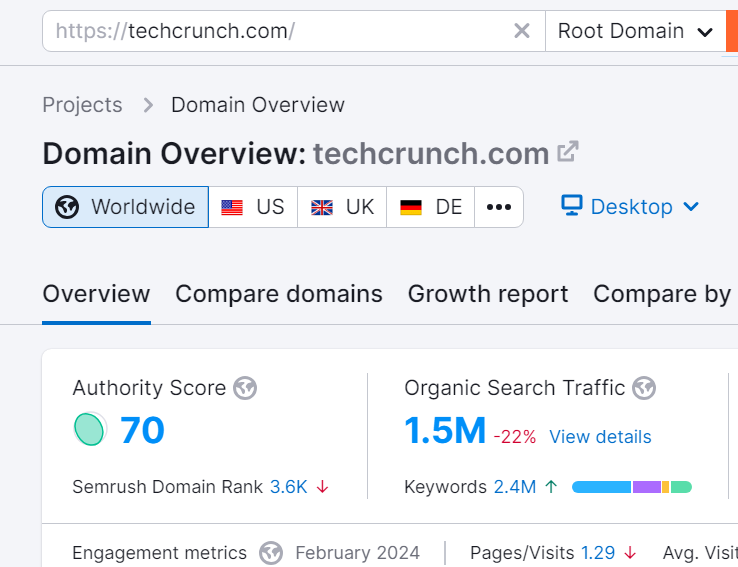
With these impressive numbers, we can easily sum up that Techcrunch is a high authority website.
This obviously means that if you’re able to publish a guest post article on high-authority website like TechCrunch then it can do wonders to your website’s organic ranking.
To cite another example, I found the domain authority of another website called ShoutMeLoud. As you can clearly see ShoutMeLoud has a domain authority of ’45.’
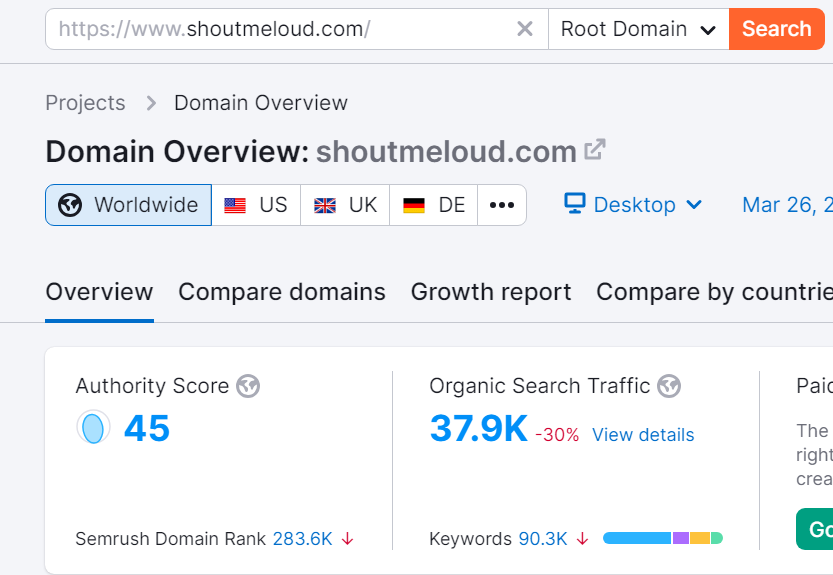
Likewise, you can check the domain authority of any website by using SEO tools like SEMrush and Ahrefs.
- Write high-quality article:
Writing high quality article is obviously one aspect that simply cannot be overlooked. More so, if your article gets rejected due to poor quality then all the time and energy you’ve invested will lead to nothing. In this context, it is important to remember that most high authority websites have very strict editorial guidelines for publishing guest post articles. And writing high-quality and top-notch article being the most important guideline among all.
You can achieve success in this critical task by resorting to thorough research. There are primarily two types research when it comes to any article. First is qualitative research and second is keyword research.
- Qualitative research: As the name itself suggests that this research helps in improving and enhancing the overall quality of the article. Cover every possible angle and aspect of your topic. Enrich your article with key data and statistics and show them off through engaging charts and graphs. To sum it up, your article should reflect the fact that you’re an expertise in your field or a leading industry expert who has something invaluable to share with his targeted readers. On this point, I’d like to specify that your article should fully satisfy the search-intent and the EAT principle.
- Keyword research: Keyword research is absolute must for any SEO related articles, more so when it comes to guest post articles. Your article may be the most high-quality article, but it won’t have any SEO impact if it does not include necessary keywords. Although today Google has become smart enough to understand the context and semantic meaning of the article, it is still important to stick to the traditional method of including all main keywords in your article.
To dig up main keywords and also secondary or LSI keywords, you can again take the help of paid tools like SEMrush and Ahrefs. I especially consider SEMrush’s keyword magic tool as one of the best keyword tools available in the market.
- Optimize content for SEO:
Since the entire purpose of guest posting is to skyrocket your SEO efforts, it obviously makes sense that your content has to optimize for SEO. A SEO friendly article is what will ultimately help your guest posts to gain the spotlight in Google’s SERP. After all, SEO stands for search engine optimization, which actually means that your content has to be optimized for a search engine.
Notably, a properly SEO optimized content also helps the host website as it helps in attracting traffic into the website.
Here I’d also like to specifically mention that optimizing your content for a search engine should never come at the cost of your targeted readers. Your targeted readers should always be the main focus of your article.
On this note, let us finally talk about how to go about in optimizing your content. Below I’ve given the checklist to help you with SEO optimization.
- Optimize your Title tag.
- Format and structure your article in subsections, for e.g. H1, H2, H3.
- Make sure to use primary and secondary keywords in H1, H2 & all other headings.
- Ensure that your keywords are contextually placed.
- Make sure that your article satisfies the search intent & fulfils the EAT principle.
- Keyword stuffing is a big no.
- Make sure to end the article with a proper conclusion.
- Focus on Anchor Text:
Anchor text plays a very critical role in guest posting as this is the actual place where backlink is created. Anchor text actually refers to the clickable text usually seen in a hyperlink format that links back to your website.
Here are some of do’s and don’t of Anchor Text. Following these do’s and don’ts will ensure that your guest blog ends up passing link juice back to your website.
- Keywords in the anchor text must be naturally & contextually placed.
- Avoid keyword stuffing. Using too many keywords in anchor text is a big red flag.
- Keep it as concise as possible.
- Write anchor text for readers and not for search engines.
Conclusion:
By following these best practices, your guest post article can maximize the reward. Guest post articles can actually prove to be a game changer for your entire business. Treat it like a key that will unlock the floodgates to drive huge amount of traffic to your website, eventually opening huge possibilities of growth for your business. Hence it is imperative to not take guest blogging articles for granted and follow all the rules with diligence.